Research
PHOTONICS & COMPLEX OPTICAL SYSTEMS
1. Optical Lattices, Waveguiding & Topological insulators
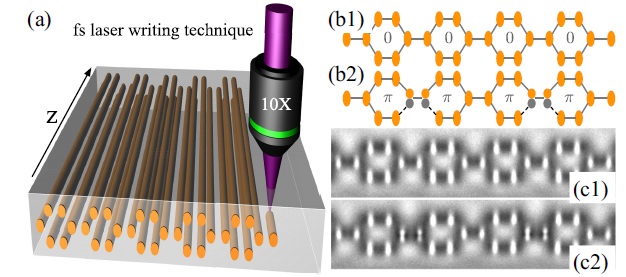
We explore nonlinear and discrete photonic lattices—networks of coupled optical elements—where light transport is orchestrated by engineered couplings, long-range interactions, and topological design. We study a rich variety of phenomena: localized and symmetry-protected modes that resist scattering, edge states that channel light along boundaries regardless of defects, and flat-band regimes that suppress diffraction and amplify nonlinear effects. These systems offer a fertile playground for investigating fundamental physics, including topological phases, non-Hermitian optics, and many-body light dynamics, while simultaneously serving as blueprints for advanced photonic devices.
2. Applications in Sensing, Signal Routing & Integrated Optics
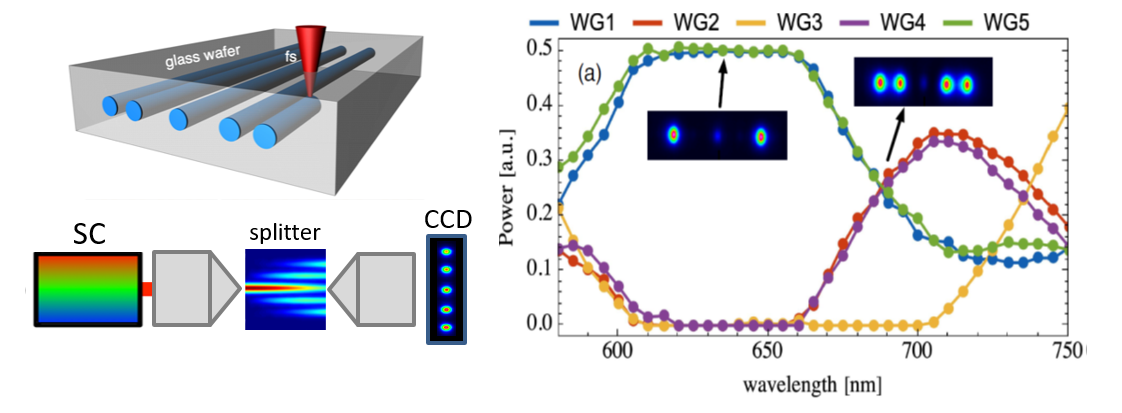
Photonics research is strongly connected to application-driven development. Our group designs and evaluates structures and systems for: Optical and hybrid optical–electrical sensors; Robust photonic signal routing through engineered lattices and waveguide networks; Integrated optical components for lab-on-chip; Fibre-based sensing platforms for environmental and biomedical applications.
3. Terahertz Photonics & Metamaterials
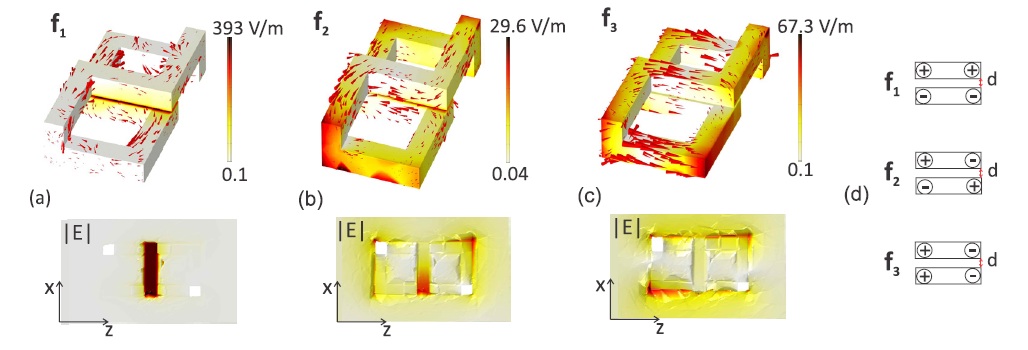
We design and investigate advanced photonic materials—graphene-based and chiral metamaterials—that provide dynamic, tunable manipulation of electromagnetic waves, particularly in the terahertz (THz) regime. Graphene metasurfaces offer electrically reconfigurable control over amplitude, phase, and polarization with picosecond switching speeds, while chiral metamaterials deliver exceptional optical activity and circular-polarization selectivity through structured asymmetry. By combining these platforms and exploring hybrid reconfigurable architectures, we achieve multifunctional wave control—from tunable modulation and polarization conversion to selective absorption and asymmetric transmission. These advances bridge fundamental photonic phenomena, such as topological phases and non-Hermitian dynamics, with practical device applications in high-resolution THz imaging, sensitive chemical and biological spectroscopy, and ultra-high-speed wireless communication for next-generation networks.